


 Virtual Trivia
 Virtual Escape Room
 Virtual Murder Mystery
 Virtual Coworker Feud
 Virtual Scavenger Hunt
 Virtual Bingo
 Virtual FIFA Activities
 Summer Team Building Activities
 Social Wellness Month
 National Intern Day
 Virtual Murder Mystery
 Virtual Bingo
 Virtual Icebreaker Games
 Online Taboo
 Virtual Cocktail & Mixology
 Virtual Food Decorating
 Virtual Tasting Experiences
 Virtual Cooking Classes
 Virtual Wellness Program
 Guided Online Meditation Class
 Virtual Yoga Class
 Team Synergy Workshops
 Virtual Paint Party
 Virtual DIY Terrarium
 Virtual Origami
 Virtual Pottery
 Virtual Marble Resin Class


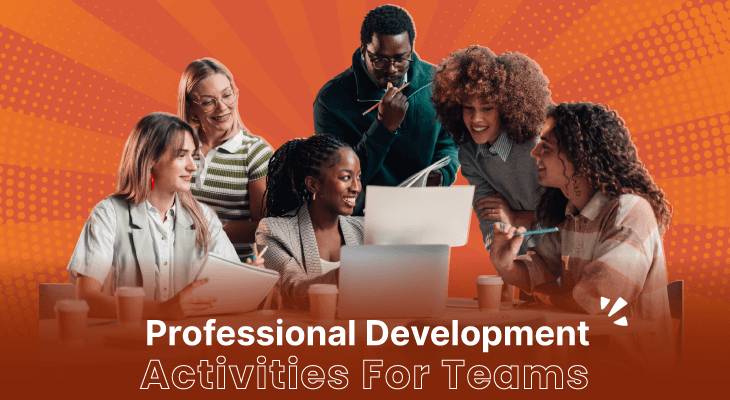
Professional development is no longer just about attending training sessions or earning certifications. Today, it also means learning how to work with AI, adapt to new technology, solve problems, and make smarter decisions in a fast-changing workplace. Professional development activities can help employees build practical skills, adapt to the latest industry trends, and advance their careers.
In this article, we’ll cover:
- Activities that build workplace and professional skills
- AI-focused learning activities for modern teams
- Problem-solving and creative thinking exercises
- Teamwork and collaboration activities
- Leadership and decision-making experiences
- Mindfulness and stress management activities
- Resilience and emotional intelligence training
- Activities that support long-term career growth
Table of Contents
- Quick Glance: Best Professional Development Activities
- What are Professional Development Activities?
- How Can Professional Development Activities Help Your Team Grow?
- 22 Best Professional Development Activities for Teams
- Skill-Building Activities for Work Teams
- AI & Future-Ready Learning
- Collaboration and Teamwork Development Activities
- Leadership & Decision-Making Activities for Teams
- Focus & Workplace Resilience Activities
- Frequently Asked Questions
Quick Glance: Best Professional Development Activities
| Activity | Best For | Key Skills Developed | Works Best With | Difficulty |
|---|---|---|---|---|
| Software & Tool Training Workshops | Improving technical proficiency | Software skills, efficiency, digital workflows | Department-specific teams | Beginner |
| Build Your Own GPT | Learning practical AI skills | AI literacy, prompt writing, automation | Cross-functional teams | Intermediate |
| Collaborative Art Sessions | Encouraging creative collaboration | Creativity, communication, teamwork | Small to medium teams | Beginner |
| Mentorship Roundtables | Learning from experienced professionals | Decision-making, leadership, career development | Employees at all levels | Beginner |
| Project Management Simulations | Practicing real-world project execution | Planning, prioritization, resource management, collaboration | Cross-functional project teams | Intermediate |
| Mindfulness Activities | Building focus and resilience | Stress management, self-awareness, concentration | Teams of any size | Beginner |
What are Professional Development Activities?
Professional development activities are exercises, workshops, or training programs that help employees build new skills and grow in their careers. These activities can focus on a wide range of areas such as communication, leadership, productivity, AI, or time management. Some examples of activities for professional development include lunch-and-learn sessions, AI productivity bootcamps, problem-solving games, and innovation workshops.
How Can Professional Development Activities Help Your Team Grow?
Rapid advancements in technology mean employees must continuously learn, upskill, and adapt to new ways of working. The activities for professional development can help teams grow in the following ways:
- Skill development: Helps employees build practical workplace skills such as communication, problem-solving, time management, and project coordination.
- Career growth: Prepares employees for promotions, leadership opportunities, and greater responsibilities within the organization.
- Future-readiness: Helps teams stay current with new technologies, industry trends, evolving workflows, and changing business needs.
- Employee engagement: Creates opportunities for learning and growth, helping employees feel more invested in their work and future.
- Self-management: Helps employees improve focus, manage their time effectively, handle stress, and stay productive throughout the workday.

22 Best Professional Development Activities for Teams
Whether your team is remote, hybrid, or in the office, these 20 professional development activities help employees build communication, leadership, AI, productivity, and workplace resilience skills.
Skill-Building Activities for Work Teams
Master essential workplace skills like communication, productivity, software proficiency, and industry knowledge with these practical professional development activities.
1. Software and Tool Training Workshop
Employees often use only a fraction of the features available in the workplace tools they rely on every day. Dedicated training can upskill teams in specific applications or industry-specific tools. Teams can learn advanced formulas, workflow automation, dashboard creation, project tracking, reporting techniques, and other features to work more efficiently.
Here are some software training workshop ideas for different teams:
- Developing Team: GitHub, Jira, Docker, Kubernetes, or AWS training workshops.
- Digital Marketing Teams: Google Analytics 4, HubSpot, Semrush, Ahrefs, or Google Ads workshops.
- Sales Teams: Salesforce, HubSpot CRM, Gong, or LinkedIn Sales Navigator training.
- Project Management Teams: Asana, Monday.com, Jira, Smartsheet, or Notion workshops.
- Data and Analytics Teams: Tableau, Power BI, SQL, Looker, or Excel advanced analytics training.
- Design Teams: Figma, Adobe Creative Cloud, Canva, or Miro workshops.
- HR Teams: Workday, BambooHR, Greenhouse, or Culture Amp training sessions.
Best for: Teams adopting new software or looking to improve tool proficiency
2. Professional Certifications and Accreditation Programs
Unlike most workplace training sessions, certifications and accreditation programs typically follow a defined curriculum and include an assessment at the end. Employees can complete these courses at their own pace or for a pre-defined duration, and add them later to their resumes and professional profiles. These credentials offer an alternative to traditional degree programs while helping employees develop skills for specialized, often higher-paying roles.
Consider these certification programs for different teams and departments:
- Project Management: PMP, CAPM, PRINCE2, or Certified ScrumMaster (CSM)
- Data and Analytics: Google Data Analytics Certificate, Microsoft Power BI Data Analyst, Tableau Certified Data Analyst, or AWS Data Analytics
- Digital Marketing: Google Analytics Certification, Google Ads Certification, HubSpot Marketing Certification, or Meta Certified Digital Marketing Associate
- Cloud and IT: AWS Certified Solutions Architect, Microsoft Azure Fundamentals, Google Cloud Digital Leader, or CompTIA Security+
- Cybersecurity: Certified Ethical Hacker (CEH), CISSP, CompTIA Security+, or Certified Cloud Security Professional (CCSP)
Best for: Employees preparing for specialized or advanced roles
3. Time Management and Productivity Worskhops
Balancing multiple tasks and deadlines throughout the day can be challenging for any employee. Time management and productivity workshops help teams prioritize work, organize workloads, and manage competing demands more effectively. These workshops typically cover topics such as time blocking, priority matrices, goal setting, meeting management, and productivity systems.
Here are some popular time management and productivity workshops:
- Make It Count: Maximizing Time Management Workshop – Hooray Teams
- Productivity & Prioritization Workshop – LifeLabs Learning
- The 5 Choices to Extraordinary Productivity – FranklinCovey
- Time Management Essentials – FranklinCovey
- Time Management – American Management Association (AMA)
- Productivity & Prioritization Program – LifeLabs Learning
Best for: Teams juggling multiple projects, deadlines, or priorities
4. Business Communication Skills Training
Teams spend a large part of their day communicating, whether through meetings, emails, presentations, or one-on-one conversations. Business communication training helps employees communicate clearly and confidently across in-person, remote, and hybrid workplaces. Participants practice skills such as clear writing, active listening, presentation delivery, and handling workplace conversations with different audiences.
Popular business communication training programs include:
- Workplace Communication Training Course – AMA
- Business Communication Course – JHU Carey Business School
- Effective Communication Course – Dale Carnegie
- Communication Skills Training – Pryor Learning
- Business Communication Skills – Dale Carnegie
Best for: Remote, hybrid, and client-facing teams
AI & Future-Ready Learning
Knowing how to use AI is becoming as important as knowing how to use workplace software. This section covers interactive learning experiences that help teams experiment with AI tools, write better prompts, automate tasks, and explore new ways of working.
5. Build Your Own GPT
Many teams already use AI to write emails, summarize notes, or brainstorm ideas. This activity takes things a step further by challenging participants to build a custom GPT for a real workplace need. Teams can create AI assistants and gain hands-on experience with prompt design, knowledge uploads, testing workflows, and AI customization tools.
You can build GPTs around real workplace use cases, such as:
- HR Policy Assistant: Answers questions about company policies, benefits, onboarding, and leave procedures.
- Sales Enablement GPT: Assists with product information, objection handling, competitive comparisons, and follow-up emails.
- Project Management GPT: Generates project plans, meeting summaries, status updates, and risk assessments.
- Customer Support GPT: Drafts responses to common customer questions using company-specific information.
- Content Creation GPT: Produces blog outlines, social media captions, email drafts, and marketing content.
- Data Insights GPT: Analyzes spreadsheets, summarizes trends, and generates reports from recurring datasets.
Best for: Teams exploring AI for everyday work
6. Prompt Engineering & AI Analytics
Getting useful results from AI often depends on the quality of the instructions behind it. A prompt engineering and AI analytics workshop helps professionals learn to communicate effectively with large language models (LLMs) to generate desired results.
Participants can also explore how AI platforms track usage, identify patterns, generate insights, and support data-driven work. Workshop topics often range from core prompting techniques and LLM fundamentals to business intelligence, data visualization, and AI-powered automation.
Best for: Tech teams who regularly use AI tools
7. Designing with AI
Creating presentations, social media graphics, marketing materials, illustrations, and other visual content no longer requires advanced design skills. An AI design workshop introduces teams to AI-powered design tools that can generate images, edit visuals, create brand assets, build presentations, and speed up creative workflows.
Participants can experiment with platforms like ChatGPT, Canva AI, Adobe Firefly, Midjourney, and Microsoft Designer while learning how prompts, styles, and visual references influence the final output.
Best for: Marketing, design, content, and creative teams
8. AI Productivity Bootcamp
An AI Productivity Bootcamp is a hands-on training program that teaches employees how to use AI tools to automate everyday tasks. Participants learn to work with AI assistants, build automated workflows, and integrate AI with existing software to save time and improve productivity.
Some areas where teams can integrate AI into everyday work include:
- Drafting emails, follow-ups, and other routine communications.
- Summarizing meetings and keeping track of next steps.
- Creating onboarding materials and training resources.
- Reviewing data and turning it into easy-to-understand insights.
- Creating reports, proposals, and internal documents.
- Tracking business performance and spotting important trends.
Best for: Teams looking to automate repetitive tasks
9. Human + AI Collaboration Workshop
Using AI effectively isn’t just about writing better prompts—it’s about knowing when to rely on AI, when human judgment matters most, and how the two can work together. In a Human + AI Collaboration Workshop, teams tackle real workplace scenarios using both their own expertise and AI tools, then compare the results to understand where each adds the most value.
Participants learn how to review AI-generated content critically, identify inaccuracies or bias, refine outputs, and make informed decisions instead of accepting AI responses at face value. The workshop also explores responsible AI use, data privacy, and best practices for collaborating with AI in everyday work.
Some hands-on activities may include:
- Solving the same workplace problem with and without AI to compare outcomes.
- Reviewing AI-generated reports for accuracy, tone, and potential bias.
- Collaborating with AI to brainstorm ideas before refining them as a team.
- Evaluating when human creativity, empathy, or critical thinking produces better results than AI alone.
- Discussing responsible AI use, privacy, and company AI guidelines.
Best for: Cross-functional teams adopting AI into everyday workflows
Collaboration and Teamwork Development Activities
Explore activities that encourage employees to think creatively and solve problems together.
10. Problem-Solving Games
Professional development can be a lot more engaging when learning feels like a challenge instead of a lesson. Problem-solving games put teams in situations where they need to think, discuss, and figure things out together. From solving mysteries to navigating simulated crises, these activities offer a hands-on way to practice critical thinking and collaborative decision-making.
Some popular problem-solving games include:
- Escape Rooms: Teams solve a series of clues and puzzles to complete a mission before time runs out.
- Murder Mystery Games: Participants gather evidence, question suspects, and piece together the story to identify the culprit.
- Desert Island Survival: Teams must prioritize a limited set of resources and agree on a plan to survive on a fictional deserted island.
- Crisis Council: Participants respond to a simulated crisis, evaluate options, and make time-sensitive decisions as a team.
Best for: Cross-functional teams and new project groups
11. Collaborative Art Sessions
Creating art as a team gives employees a chance to think creatively while working toward a shared goal. Teams work around a theme or prompt and contribute to a single project using simple craft supplies or digital tools. Throughout the activity, employees practice communication, collaboration, and creative thinking as they share ideas, build on each other’s suggestions, and make decisions together.
Popular team art projects include round-robin drawing, team murals, themed collages, and group sculpture-building. The focus is on strengthening workplace skills rather than artistic ability.
Best for: Teams looking to improve collaboration and idea sharing.
12. Innovation Workshops
Innovation workshops help teams brainstorm ideas and find creative solutions to improve existing work processes. Teams are given real or scenario-based problems and asked to break them down, rethink approaches, and build new solutions together. This can involve redesigning workflows, quickly testing multiple ideas, or approaching a problem from completely different angles before settling on what works best.
We recently hosted an innovation workshop where teams tackled a real workplace challenge using a structured five-step framework. Here’s how we ran it:
Round 1: Brainstorming ideas: Teams generated as many ideas as possible without judging or filtering them in the moment.
Round 2: Breaking down the problem: Teams analyze the challenge to understand what’s actually causing the issue or delay.
Round 3: Exploring creative solutions: Our team looked at different approaches and suggested multiple ways to improve the process or idea.
Round 4: Shortlisting: Teams narrow down ideas based on feasibility, impact, and ease of execution.
Round 5: Action Planning : Our team turned the shortlisted ideas into clear next steps and discussed how they would be applied in real work situations.
Best for: Teams responsible for improving products, services, or internal processes
13. Vision Board Creation
Vision board making is a hands-on professional development activity where teams express their goals and ideas visually. Participants use images, words, sketches, or digital tools to map out ideas around personal growth, team direction, or workplace aspirations. The activity that helps employees clarify career goals, boost motivation, and promote self-reflection.
Here are a few ways teams can do vision board making:
- Team Growth Vision Board: Teams visually map skills, learning goals, and areas of improvement they want to focus on.
- Project Roadmap Board: Groups outline key milestones, timelines, and focus areas for an upcoming project.
- Work Culture Board: Teams design a visual representation of the kind of workplace environment they want to build together.
- Future Workspace Board: Participants create a visual idea of their ideal work setup or environment.
Best for: New hires and interns
Leadership & Decision-Making Activities for Teams
Explore activities that help build employees’ decision-making, communication, and leadership skills.
14. Mentorship Roundtables
Give employees a chance to learn from people who have already faced the challenges they’re working through today. In these roundtable discussions, teams ask questions, talk through workplace situations, exchange ideas, and hear how experienced professionals approach leadership, decision-making, and career growth. The open discussion encourages employees to think beyond their own perspective and learn from real experiences.
Participants can also bring up situations they are currently facing at work. Mentors explain how they would approach them, what they would consider before making a decision, and the lessons they have learned along the way. These conversations help employees build confidence, develop better judgment, and apply practical insights to their own work.
Best for: Interns and aspiring leaders
15. Project Management Simulations
Working on a realistic project is one of the best ways for employees to build practical project management skills. Give teams a project to complete, set a tight deadline, limit the resources they can use, and introduce a few unexpected twists along the way. Participants work through realistic scenarios, make decisions in real time, and collaborate to keep the project on track despite changing circumstances.
Teams might need to handle budget constraints, shifting deadlines, stakeholder feedback, changing project requirements, or an unexpected absence of a team member. Success depends on how well they prioritize tasks, communicate with one another, manage resources, and adapt when plans don’t go as expected.
Best for: Project managers, team leads, and aspiring project managers
16. Change Management Simulation
Workplaces are constantly evolving, whether it’s adopting new technology, restructuring teams, or introducing new processes. A change management simulation gives employees the opportunity to navigate these transitions in a realistic, low-risk environment. Participants work through workplace scenarios where priorities shift, unexpected challenges arise, and they must adapt while keeping projects and teams moving forward.
Throughout the activity, teams practice communicating through uncertainty, managing resistance, making informed decisions, and supporting colleagues during periods of change. By the end of the simulation, participants gain practical strategies for staying adaptable, resilient, and productive when workplace changes occur.
Here are some common change management scenarios teams can work through:
- Rolling out a new AI tool or workplace technology across departments.
- Managing resistance during a company-wide process or policy change.
- Adapting to shifting project priorities and tight deadlines.
- Navigating organizational restructuring or team reorganizations.
- Leading employees through mergers, acquisitions, or rapid business growth.
Best for: Managers, team leads, project teams, and organizations navigating workplace change
17. Crisis Management Exercises
Not all workplace situations unfold in a predictable way. Crisis management exercises challenge teams to respond to unexpected situations with limited information. Give teams a developing situation and introduce new updates in stages so they have to react, adjust plans, and communicate on the go.
The focus is on making quick, practical decisions while keeping the situation under control as conditions change. These exercises may include situations like sudden system outages, urgent client escalations, operational breakdowns, last-minute deadline changes, and communication failures that require immediate action.
Best for: Managers, operations teams, and crisis response teams
18. Leadership Decision Role Plays
Leadership decisions often involve different perspectives, and this activity helps teams explore how choices change based on context and viewpoint. Teams handle real workplace situations where they need to make choices and defend decisions in real time. Each participant takes on a role such as manager, team member, or stakeholder, and the situation evolves based on how they respond.
Teams have to explain their choices, handle disagreements, and adjust decisions based on new inputs from others in the group. You and your team might face situations such as handling underperforming projects, managing stakeholder disagreements, or responding to sudden changes in project direction.
Best for: New managers, supervisors, and future leaders
Explore top leadership team building ideas that work anywhere.
Focus & Workplace Resilience Activities
Explore practical activities to manage stress, improve emotional awareness, and maintain productivity under pressure.
19. Mindfulness Activities
Long work hours, team meetings, and back-to-back tasks can leave employees feeling mentally drained. Mindfulness activities help employees improve focus, manage stress, and build mental resilience for the workday. These sessions are usually designed in short, easy formats that help employees slow down, reduce mental clutter, and recharge at work.
Here are some mindfulness activities for your team:
- Breathing practices: Box Breathing, five finger breathing, 2-1-4 calming breath, alternate nostril breathing
- Sensory awareness exercises: The Raisin Exercise, herbal tea tasting, sound mapping walk
- Yoga & movement breaks: Desk yoga, pilates, guided meditation, neck & shoulder release routine
- Creative activities: Mandala painting, Zen Doodling, pattern sketching, pottery making
Best for: Employees in high-pressure roles and busy teams
20. Stress Management Workshops
Work-related stress is a part of almost every job, but knowing how to manage it can make a big difference. Stress management workshops help employees recognize common stress triggers, build healthy coping strategies, and develop habits that support well-being without affecting productivity. These sessions often cover topics like mindfulness, emotional regulation, work-life balance, relaxation techniques, and preventing burnout.
Some popular stress management workshops include:
- Stress Management Workshop – Hooray Teams
- Managing Stress at Work – FranklinCovey
- Stress Management & Resiliency Training (SMART) – Harvard
- Mindful Stress Management – NASM
- Stress Management for the Workplace – Clarity Seminars
Best for: Employees experiencing heavy workloads or workplace change
21. Emotional Intelligence Training
The way employees respond to feedback, handle disagreements, and support colleagues can have a lasting impact on team dynamics. Emotional intelligence training focuses on understanding emotions, communicating with empathy, managing reactions, and building stronger workplace relationships. Through interactive exercises, discussions, and real-life scenarios, employees learn skills that improve teamwork, leadership, conflict resolution, and everyday communication.
Here are some popular emotional intelligence training programs:
- Emotional Intelligence – TalentSmartEQ
- Emotional Intelligence Workshop – American Management Association (AMA)
- Developing Emotional Intelligence – Center for Creative Leadership (CCL)
- Emotional Intelligence Training – Six Seconds
- Emotional Intelligence at Work – Fred Pryor Seminars
Best for: Managers, team leads, and customer-facing employees
22. Resilience and Growth Mindset Workshops
Change, setbacks, and new challenges are part of every workplace. Resilience and growth-mindset workshops help employees adapt with confidence, learn from mistakes, and approach challenges as opportunities to grow. These sessions focus on building mental resilience, developing a positive outlook, managing change, and strengthening the mindset needed to keep learning and improving over time.
Here are some popular resilience and growth mindset workshops for teams:
- Building a Resilient Mindset – American Management Association (AMA)
- Resilience Training – Center for Creative Leadership (CCL)
- Building Resilient Cultures Through Change – FranklinCovey
- Building a Resilient Mindset – The Oxford Group
- The Resilient Mindset Lab – Helm 365
Best for: Teams navigating change, new managers, and emerging leaders
Frequently Asked Questions
What skills can teams develop through professional development activities?
Teams can develop a wide range of skills, including communication, leadership, critical thinking, decision-making, adaptability, collaboration, creativity, and conflict resolution.
How do we choose the right professional development activity for teams?
Start by identifying the skills you want your team to strengthen. For example, communication-focused teams may benefit from collaboration challenges, while teams looking to improve strategic thinking may enjoy escape rooms, simulations, or problem-solving games.
How often should teams participate in professional development activities?
You can schedule activities for professional development monthly or quarterly. The ideal frequency depends on team goals, workloads, and the type of skills you want your team to develop.
What are some virtual professional development activities for employees?
Virtual activities for professional development can include skill-building workshops, professional certification courses, virtual mentorship programs, peer learning sessions, virtual hackathons, lunch-and-learns, and collaborative problem-solving exercises.
How long do employee professional development activities usually last?
A professional development activity can range from 30-minute learning sessions to half-day workshops or full-day team events. The best format depends on the activity and the team’s availability.
What are some fun professional development activities for staff?
Fun professional development activities for staff include team hackathons, escape rooms, Shark Tank, murder mystery, sudoku, and mentorship programs.